The big question
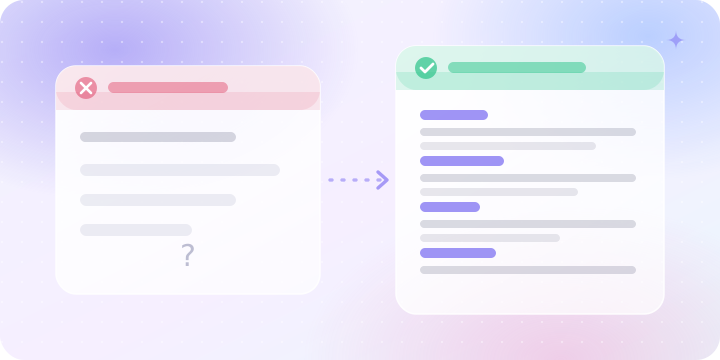
Why do two people ask AI the same thing, but one gets magic and the other gets nonsense? Because the AI does not only respond to your idea — it responds to your instructions.
A weak prompt says “Make something nice.” A strong prompt says “Make a clean 7-slide company profile for investors, using a luxury tone, short text, and clear section titles.” One is a wish. The other is direction.
Prompting is like ordering coffee
Walk into a café and say “give me coffee” — you might get black coffee, a latte, or something with oat milk and confusion. Say “I want an iced latte, medium, oat milk, less sugar, takeaway” and you get exactly that.
AI works the same way: the more useful detail you give, the better the result.
A — “Make me a logo.”
B — “Create a minimal luxury logo for a Dubai real estate company, using navy and gold, with a clean icon and no complicated details.”
Show answer
B wins — it gives the AI direction, style, industry, colors, and limits.
The prompt quality meter
A prompt usually has five power levels. Level 1 — one word: “Website”. Level 2 — basic: “Create a website.” Level 3 — some context: “Create a website for my company.” Level 4 — clear direction: “Create a modern company website for a real estate developer in Dubai.” Level 5 — strong: “Create a modern company website for a Dubai real estate developer. Include Home, About, Projects, Amenities, Contact. Use a luxury tone, clean layout, short sections, and clear CTAs.”
Level 5 is where the good stuff starts.
What a prompt actually does
A good prompt tells the AI who to act as (designer, writer, developer, marketer), what to create (a blog, image, website, presentation), who it is for (clients, investors, students, customers), how it should feel (luxury, friendly, corporate, bold), and what to avoid (no long paragraphs, no fake numbers, no messy layout). That is the whole game.
“Write about AI.”
Too open, too generic. No audience, no format, no goal.
“Write a short beginner-friendly blog about how AI helps designers. Use simple language, fun examples, short sections, and end with a checklist.”
Topic, audience, tone, format, and a clear ending.
- A. Audience
- B. Number of slides
- C. Design style
- D. All of the above
Reveal answer
D. All of the above — the AI needs to know who it is for, how long it should be, and how it should look.
- Did I say what I want?
- Did I say who it is for?
- Did I mention the style?
- Did I mention the format?
- Did I say what to avoid?
- Did I give enough context?
Ready-to-copy prompt
Act as a [role].
Create a [type of output] about [topic].
The audience is [audience].
Use a [tone/style] style.
The format should be [format].
Include [important points].
Avoid [things to avoid].
Act as a creative content writer.
Create a short Instagram carousel about why prompting matters.
The audience is beginners using AI for work.
Use a fun, simple, and friendly tone.
The format should be 7 slides.
Include examples, mistakes, and a final checklist.
Avoid long paragraphs and technical language.
Final takeaway
AI is not magic because it guesses. It feels like magic when you guide it well. So next time, don't just ask — direct, shape, guide. That is prompting.